Book Review: The Power of Now by Eckhart Tolle

The Power of Now by Eckhart Tolle“Everything that needs to be said has already been said. But since no one was listening, everything must be said again.” Especially so, methinks, when it comes to the business of getting enlightened.

The Power Of Now by Eckhart Tolle was a book I had heard about on and off but never got around to it. But I am ever so glad I did. It is in a question-answer format based on the authors talks and the questions he was asked. The few main concepts appear repeatedly throughout the chapters only to drive the point home so the reader really gets it. Tolle, from time to time, quotes from the New Testament, Zen, Buddhism, Hinduism, Sufism asserting that his teaching is nothing new and is already present in the teachings of the major world religions.

I listened to the audiobook that worked best in my situation where taking time out specifically to read was not working out. The authors calm voice would even put me to sleep, if I was listening lying down after the days work! Ha! But the best part of  an audiobook is I play it over and over while I’m doing work around the house as against picking up the book to read all over again.

The Main Ideas:

1) You are NOT your thoughts
This plants a seed in us of the concept that thoughts are an independent thing separate from the One who is observing them.

I found it interesting how the mind (and the thoughts it generates) were significantly dwarfed in comparison to the much higher concept of its Owner. The mind is more or less like a limb or the eyes, very important, yet but a part of the whole. Unfortunately, a majority of the world is suffering from the epidemic of “incessant thinking” and the mind has taken over its Master, the Self.

2) Time and the mind is one and the same thing
Imagine the Earth devoid of human life, inhabited only by plants and animals. The question “What time is it?” or “What’s the date ?” would be quite meaningless. The oak tree or the eagle would be bemused by such a question. “What time?” they would ask. “Well, of course, it’s now. What else is there?” The predominance of mind is no more than a stage in the evolution of consciousness. We need to go on to the next stage now as a matter of urgency lest the human race destroy itself.

The eternal ‘Present’ is the space within which ones whole life unfolds. Life is now. The past is a memory trace stored in the mind of a former Now. The future is an imagined Now and when the future comes, it comes as the Now.

3) All teachings are but signposts
All spiritual teachings only point to the one Reality that can not be described in the realm of words of any language. People might talk endlessly about ‘God’ without ever knowing or experiencing the Reality that the word points to.

Reminds me of how it is said beautifully in the Tao Te Ching about the Tao (the mysterious Way of the universe): those who know do not speak of it, those who speak do not know!

4) Emotional Pain Body
This is an autonomous entity in itself residing in us that is formed by pain experienced and accumulated the past and present. It feeds on pain and wants to survive by either suffering or inflicting pain on oneself or others. To acknowledge and observe it in oneself is the beginning of its end. A nice piece in the Huffington Post here.

This concept is of significance (and could be very helpful) in intimate relationships, as that’s where one can see the pain body awaken and create trouble.

5) Inner Body
In the past seekers have held the body as a hurdle to getting to enlightenment. Like the Buddha himself, who subject his body to extremes for six years trying to transcend it and realized that it was futile. Tolle says that the body is in fact the key to getting to the Pure Consciousness or Being through what he calls the Inner Body, which is the energy field within that gives life to the physical body. He gives some ways to connect with the inner body: observing the silence without that takes you to the stillness within, concentrating on ones breath, paying total attention to routine mundane activities.

My take:
Tolle has put some abstract concepts into words skillfully. The best part about the book is that enlightenment, or ones journey towards it, does not necessarily have to be something in the distant future only after years of meditation. He shows how to experience eternity right now, as now is all there is. I really found it quite encouraging.

I experienced that ‘shift in consciousness’, if you will, when I felt that eternity in the Now with my complete presence and the absence of any thought mostly with and around Nature. It truly is beyond thoughts or words – the peace, the ecstacy. That was the coolest part. Though it might last for a short time before a thought barges in to label this ‘state’. I think we all have glimpsed it, aware or unawares, one time or the other. I have been doing meditation, or attempting it for some time now, and honestly, I don’t know what exactly am I to do with my eyes closed. I’ve read a lot of literature on it. But only a handful of times have I come out of it and felt close to how it ‘should be’. That said, being fully present every moment is meditation without having to sit in solitude, cross legged and eyes closed- something impossible for me with preschooler and a toddler!

Lord Krishna in the Bhagwad Gita tells Arjuna to put in the best and 100% in any work (fully present), not expecting the fruits of it (not thinking) but surrendering it to The Lord. This can happen when one is fully present. Conversely, being fully present brings a sort of loving detachment with the work done, as prescribed by Lord Krishna. Well, at least I see it that way!

Most of us are book hoarders in varying degrees. It gives a sense of “owning” the wisdom in them. But the best way is really to take the concepts from great books, internalize them (i.e. go beyond the intellectual stimulation and academic discussion), and most importantly practice to make them a part of you. That would be, in the truest sense, owning them forever. The Power of Now is a great book with wisdom that comes from experience.
Book Review: The Continuum Concept

This is a must read for all parents to be.
The Continuum Concept by Jean Liedloff

The Continuum Concept is a book that blew my mind; I had read nothing like this before! The author Jean Liedloff spent two and a half years deep in the South American jungle living with Stone Age Indians of the Yequana tribe. This experience demolished her Western preconceptions of how we should live, and led her to a radically different view of what human nature really is. She shows us how we have lost much of our natural well-being and suggests practical ways to regain it for our children and for ourselves.

The continuum theory: “In order to achieve optimal physical, mental and emotional development, human beings, especially babies, require the kind of experience to which our human species adapted during the long process of our evolution.”

Parenting:
That said, the book brings forth ideas in stark contrast to the prevailing practices in the western world. I have to write this: there were some excerpts which were quite unsettling to me that I had to stop, collect myself and with all the courage go back to reading it; who wouldn’t be vulnerable to the idea of babies suffering? The worst part is, this ‘mistreatment’ happens at the hands of parents/ caregivers with much misguided ideas. And that is precisely why it has become my mission of sorts to strongly recommend this book to new mothers or mothers to be.

The book gives some basic practices during the initial moments, weeks and months after a child is born: constant physical contact with the mother/caregiver, co-sleeping, breast feeding on cue (and not trying to ‘discipline’ the baby at this stage by feeding at intervals that you set for them), carrying the baby around in arms, immediately responding to the child’s signals and so on. Is this not something that a mother would instinctively do, only if she is allowed to do so and not ill-tutored otherwise? Of course! However, we have some popular theories to care for the newborn that are just the opposite!

Postpartum depression: The moment the baby is born, the mother is keyed in to hold the baby, nurse and caress it. If this stimulus is not met with this right response and those moments missed, then when hours or even minutes later, the baby is finally brought to her, the mother has already gone into a psycho-biological state of mourning. The result is often that she feels guilty about not being able to ‘turn on mothering’, or to ‘love the baby very much’ as well as suffering the classic civilized tragedy called normal postpartum depressionjust when nature had her exquisitely primed for one of the deepest and most influential emotional events of her life! How unfortunate is that!

It was after reading this book that I could make sense of the what was going on with me after my first child was born (more about it in another post here).

Ancient postpartum care:
Some olden cultures have practices that are very much in line with the continuum, like the ones prevailing in India for a few thousand years (though the ‘modern’ winds are changing these ways for the worse). The mother is exclusively available for the newborn as she and the baby are assigned and confined to a room that’s not too bright (so as not to inconvenience the newborn, I guess) for 40 days. She nurses him on cue, co sleeps with the baby, gets her daily body massage, not allowed to use cold water, served fresh off the stove nutritious meals (fresh hot food is much easier to digest, especially when the new mothers digestive system is still weak) and she is assigned no housework. Elderly women – be she a distant relative, friend or even a neighbor – would come to live with them and assist the household with chores, caring for the baby and the new mother, and offer a wealth wisdom for the two. What a fantastic system it used be in the olden days! Anyway, that’s a topic in itself.

Some important continuum ideas:
The book talks about several concepts like: what the baby feels before he can think is a powerful determinant of what kind of things he thinks when thought becomes possible, and how the child’s general outlook towards life and living is shaped. Many psychological patterns, addictions, attitude, including possibly homosexuality, Liedloff believes, have their roots in the treatment of the child during their stages of infancy and childhood. Its remarkable how the Yequana treat their children that shows inherent respect and intrinsic trust. It’s all so wonderful and gives us a hopeful solution for our entire society.

The book spoke to my heart. Theories come and theories go. But what is important, I think, is that parenting in general should never be influenced by these external hypothesess, but always be guided by one’s instinct within. Be assured, with it you’ll be right on the money!

Important questions to ask oneself:
Am I (like perhaps most others), a victim of incomplete childhood? Is there something missing that I am continually looking for – an innate sense of well being and happiness-‘a natural state of being’- that seems elusive (e.g. the idea that ‘being in love would make it all right’)? Is there some emptiness that doesn’t seem to fill me up? I found some amazing perceptions that I never found in the myriad spiritual and self-help literature I’ve read for over two decades. The book put to rest some questions that had plagued me forever.

My last word:
I strongly recommend this book for two groups: those who are going to be new parents and those who have been babies at one point or another. I can’t emphasize enough- it’s a book not worth passing.

Resources to check out:
The website: http://www.continuum-concept.org/index.html
The super excellent forum: http://www.continuum-concept.org/forum/index.html (the wealth of wisdom from Continuum mothers/parents here is outstanding)

Book Review: UNBROKEN: A World War II Story Of Survival, Resilience, and Redemption

IMG_0585.JPG
What a ride!

This is a brief account of how the book affected and touched me, more than a ‘review’. This is my first book ever on the World War II, a topic I’ve always fought shy of. Deep down, I have always evaded having to live the vulnerability, suffering and horror that war brings upon people. But the fear of the idea of something is much different from and more terrifying than what it really is. This was true for me having read the book.

A gripping tale of a man and his determination, survival and optimism. I was astonished to see the human capacity to inflict cruelty and so also the human potential for endurance- and none of which was fiction! Reading though the book, I lived the life of a POW (Prisoner of War) in extreme suffering and continual dread, with no hope day after day, week after week, month after month and year after year. Then Hiroshima-Nagasaki bombings happen. It’s then that I saw the significance of it and the other side of how that finally put an end to the war! The jubilation of American victory to end the six years of misery and hardship for the whole world, put me in tearful awe. I empathized more than ever with the war veterans, and how the war experiences change them for good, and their difficulties in settling back to a ‘normal’ civilian life (if they return alive, without losing a limb or so)! It’s not just the physical, but the mental trying, that leaves the lifelong scars. And each one has to find his way out, and live amongst those who have no idea of what all their souls have endured!

Also, it gives us a reality check on our lives which is no less than kings and queens, so we better stop complaining for whatever it is!

For those who are deciding still, whether or not to read the book, this is what I have to say: it’s great storytelling, thrilling, gripping and awe inspiring. Like me, you wouldn’t leave it, if you get past the first chapter!

Book Review: Steve Jobs by Walter Isaacson

My love affair with Apple started the moment I saw the iPod Touch with a colleague back in 2007. I was impressed by the magic the device could do and it’s beauty that was simply fantastical. I owned the iPhone later and the iPad. And they never let me down. Before I knew it, I was already in awe of this cult called ‘Apple‘. I watched the company’s  CEO Steve Jobs giving the Stanford commencement speech.  It left a deep impact on me, like it did on thousands. It was unostentatious, simple and above all, great!

Standford University commencement speech by Steve Jobs

The news of Steve Jobs’ death came to me with the grief that you’d feel for the death of someone who could have been your personal hero. Since I didn’t know much about him then, I very much wanted to. I got my first iBook, “Steve Jobs” by Walter Isaacson. As I read from the Preface to the last page, it unraveled this man who had many facets, great as well as dark. Reading excerpts or news articles on him online, and watching a 60 minute documentary on TV just shows the tip of the iceberg. That’s really not him. If you wish to know this man, you got to know all the complexities that Jobs was, I felt. These words here are not meant to summarize the book; his life will need more words than these to tell the story. Many many more. This is but a trailer to entice you to watch the movie, if you wish to.

Initial reaction?

Honestly, I was slightly disillusioned towards the beginning as I was prepared to get inspired. It shattered my myth of a perfect hero to reveal the real person in real circumstances, and how he was ‘not a role model boss or a human being tidily packaged to be emulated. Driven by demons, he could drive those around him to fury and despair’. He would have his own version of reality which people around him would call “reality distortion field”. To his coworkers, he seemed too idealistic to be realistic. He was a control freak. He was straightforward to the extent of being rude, brutally rude, more often than not. He didn’t mean to be like that, he was just made that way.

Why read the Biography?

So what’s the big deal about Steve Jobs? Why read the biography? Well, there’s much more to him than this. Steve was an artist always striving relentlessly for perfection amidst imperfection. He was an ardent admirer of art and music, and was a great Dylan fan. A visionary with a beautiful vision of the future. An idealist who aimed to be, and to do things, greater than the greatest. He had an unusual ability to focus and make the impossible happen. He had a zen-like austerity, simplicity and a sense of minimalism that is reflected in all his creations. He always wanted to be at the intersection of technology and humanities.

Jobs’ passion was to create products that were great, or “insanely great”, as he would put. He was so detail oriented that he even made sure the inside parts – which the customer would never see-  also be assembled very carefully and beautifully. He didn’t believe in market research or finding out what the customer wanted (Henry Ford is believed to have once said, “If I had asked people what they wanted, they would have said faster horses!”) His philosophy was to think two steps ahead and he gave products customers didn’t know they wanted.

Quick exercise- A world without Steve / Apple?

The concept of home computers would not have started and the great GUI that made easy for one and all to use computers. Without Pixar– which broke open the frontiers of digital imagination and kids, young and old -we’d be deprived of brilliant cinema ( Toy StoryFinding NemoUp and so many more). Without the iTunes store music piracy would become the order of the day for none to contain (and we’d be deprived of the great feeling of legally buying song – not the whole CD-just for 99 cents..’click’). Without the App Store the world would be deprived of the great apps for users and the billion dollar industry that it has become. Without the iPod, iPhone and iPad, the boundaries of engineering and design would not be pushed to unimaginable limits and we would not have the joy of owning and using them (think of a music composition or a movie that most impacted you- what if it was never made?). He really didn’t ‘invent’ anything, but he was a “master at putting together ideas, art and technology in ways that invented the future”.

This is a story of a man who forever changed our world, for the better.

On the Biographer…

Walter Isaacson has more than succeeded in doing justice to the subject as a biographer, is what I believe people who knew Jobs would agree. The book progresses eloquently from Steve as a child to a college dropout to his phases of extreme diets for months, dropping acid, meditations and attempts to find enlightenment. Then are his days of becoming a millionaire in his mid twenties to a series of failures and ousting from Apple. Followed by that is his final comeback to write history and build which is now the most valuable company on earth. With these eventful circumstances one gets to know the complex personality of the man. A lot of instances in the biography, the author gives his own take on people, things and situations, starkly different from how Jobs had seen them based fact finding he did himself. He is said to have had over a hundred interviews with Jobs family, friends, colleagues and competitors and over forty interviews with Jobs himself. He seems to be very transparent and has tried the subject play a second fiddle to nothing; his writing style is simple rather than complicated verbosity.

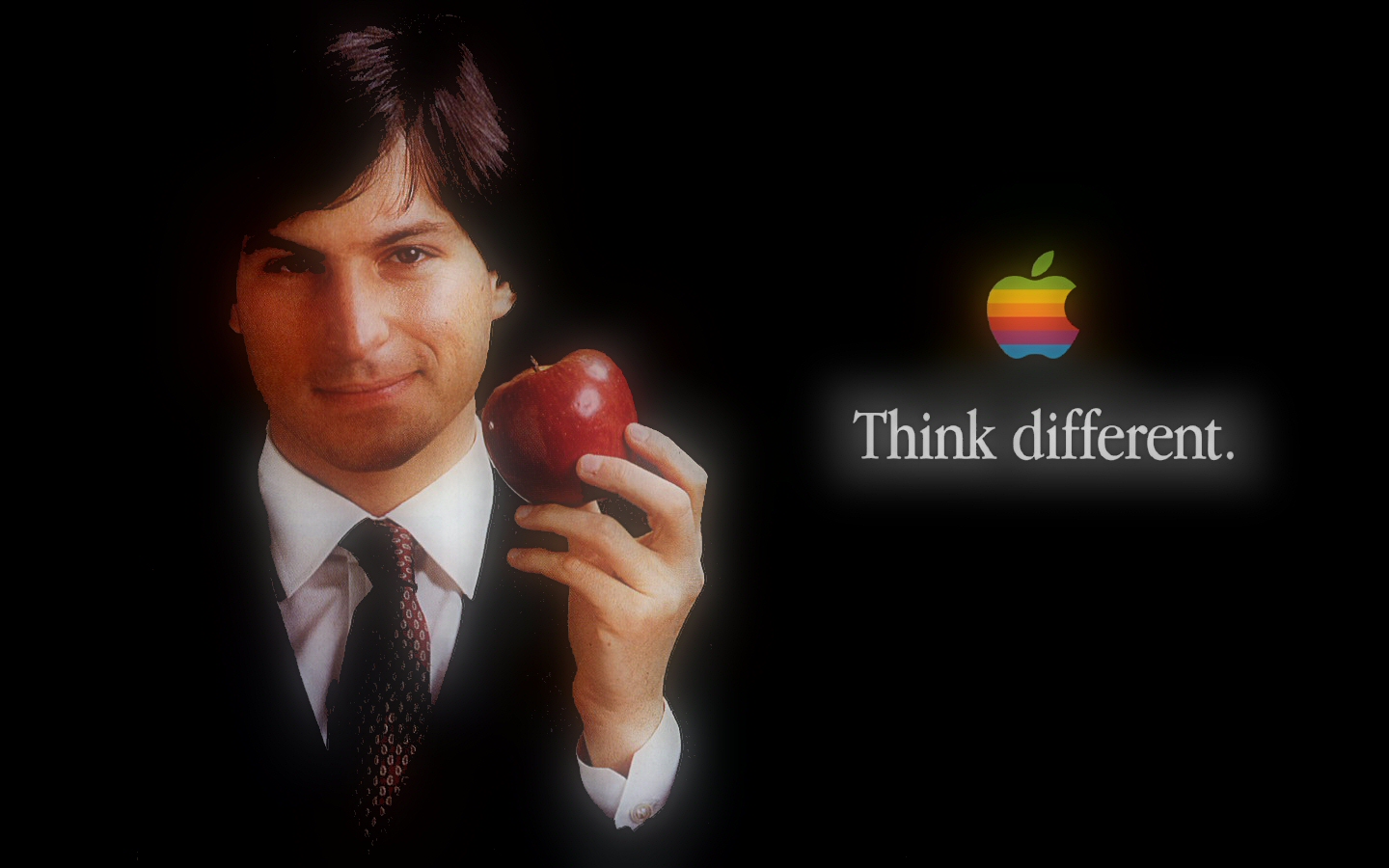
Young Steve Jobs with his Macintosh

The final words…

Most creative people in the history of human species want to express their appreciation for being able to take advantage of the contributions that came before us, and want to add something significant to the flow. To be able to contribute was the genesis of his intense drive.

Any literature that touches you leaving an impact, my father would say, is great literature! This book too leaves you with a strong sense of inspiration. You also get a sense that, the void you’d have for filling with accomplishment, has risen higher towards greatness.

Haven’t yet made up your mind to read the book? ‘Think different’!