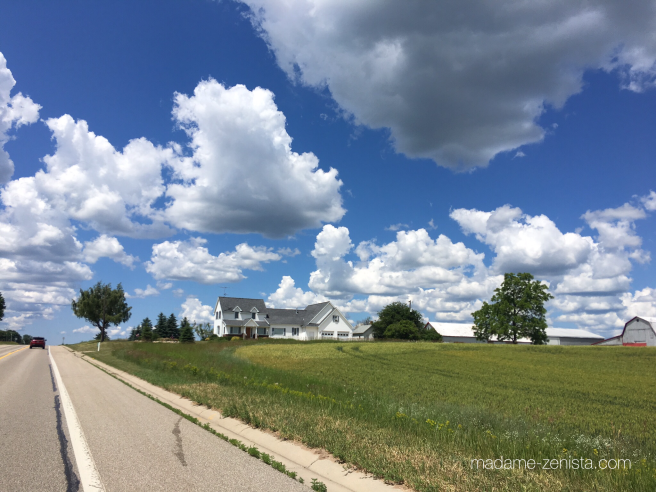
Enroute to Macknac Island, Michigan. Skyscspe # 010. #nofilter
All I Ask Is Heaven Above…
LUMINOUS sapphire skies
Woolgathering in glee
Blowing thinking-clouds
Bubbles of fantasy…
IN amber fairy dust
Blooms n’ buzzing bees
Racing to the horizon
The rolling emerald fields
THIS wanderlust I love
Nothing more I seek
All I ask, the heaven above
And the road below me…
********
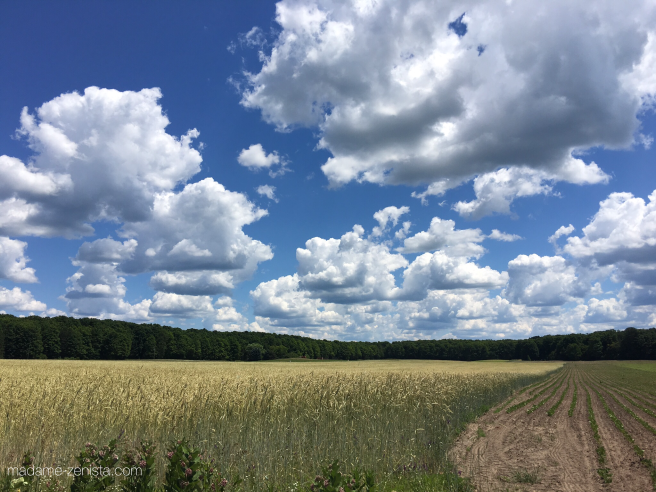
Road Trip. 2016. To Mackinac Island. Some iPhone pictures of the road, taken on the road. No filter or enhancing was needed for the stunning blues and greens.
Rolling fields in somewhere in northern Michigan. Skyscape # 011. #nofitler
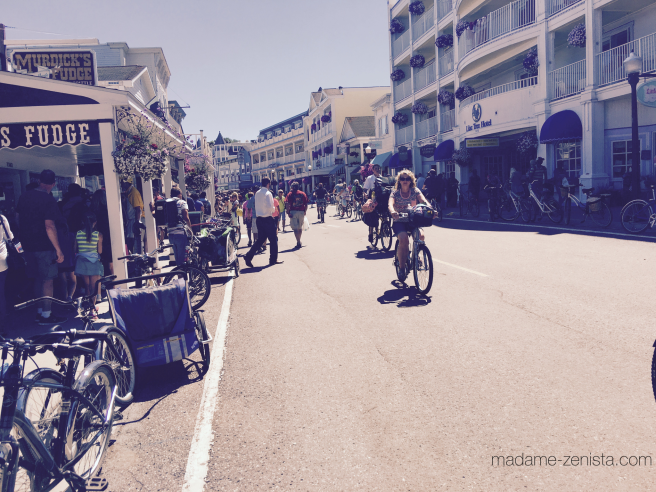
On reaching the Mackinaw City, we took a ferry to the Mackinac Island all bikes no motor vehicles.
The road in Mackinac Island where only bikes are allowed. Summer 2016.This ‘Lilac Tree Hotel’ by the roadside sporting lilac flower baskets. Mackinac Island.
Ever since I read it the first time in high school, R.L. Stevenson’s The Vagabond stayed with as a beautiful memory appealing my ‘wanderer self’. I LOVE this poem. I cant help but reproduce it here and see if you feel it speak to your soul as it did to mine.
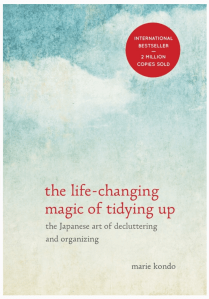
‘Zen And The Art of Minimalism’ could be an alternate title of this book by Marie Kondo. It is the English translation of the original book written in Japanese.
I am part of the Generation X, and grew up when middle class was really the middle class. We seemed to have just enough to get by and save and be debt-free. We rarely discarded anything, I remember, partly because we didn’t seem to have much to discard, and partly because we could surely ‘use it in future’. Now in the age of consumerism, it is “hoarding”, and there was an urgent need to unlearn.
That point on space & time graph:
I believe that there are trying times in all our lives that sweep us off our feet and we question everything that we have – people, relationships, things. Looking around in this moment of powerful contemplation and finding meaningless “stuff” about us, we just might have the ‘and-why-do-I-have-all-this-cr@p-anyway’ moment. I did, over a year ago when, quite serendipitously, I found this book. Because it resonated with me so much, I strongly wanted spread the word. It answered for me questions like “how do I create my Happy Place?” literally, or “how to be happy”.
The book:
With systematic steps to declutter your home, what she calls the Kon-Mari method (from her last and first names), the author writes passionately and in an honest voice. Her principle is to surround oneself with things that spark joy, and discard the rest (as much as possible). She goes a few steps further in asking readers to touch everything and see if you feel good about it, to their express gratitude for their service (something she is ridiculed for). No wonder this book seems to be a hit or a miss. Yes- there is repetition, and yes-there are suggestions that might seem beyond you. But do not take it literally, if you so disagree; take it with a grain of salt so as to not miss the important underlying principle.
Minimalism
Being idealistic and passionate, I aspire to the ideal of minimalism. In principle, one doesn’t need to have what one doesn’t need to have. More and more, I look for meaning in things and people and relationships- quality, more than quantity. Have less things, but good ones that serve your purpose that you feel happy about. Don’t let the things you own, own you.
Minimalism is not as much about figuring and discarding what you don’t want as it is about diving deep within to find what you really do. Gnothi seauton: Know thyself. Quite simple. And very difficult. When you let go of things, I think, you practice “letting go” in general, a very handy virtue. When I give up/away things with-out, it frees up energy that sort of comes back to me within. This is highly empowering. Pointing to this truth is the beauty and the value of this book.
In defense of the book:
What is an ideal? Some thing that is perfect- a highest attainable degree of excellence. Are or can humans be ideal? No-not generally. So, do we need ideals? Yes, absolutely. Because we need something to aim for. Something to go by. I wonder if religion had a similar purpose with its tenets- all point to some basic ideals (and ideally keep out of trouble with the Church and one another- but that is a whole ‘nother complex topic). A particular example that I grew up knowing is of Sri Ram in Indian mythology, called maryada purushottam, the ideal man; though no one could be all like him, the society has Him as the model to aspire to.
While The Life-Changing Magic Of Tidying Up contains tactical steps and a method to tidying up your stuff, the book is not really about things; it is actually about the ideal of living very consciously and having your home/space as an expression and extension of it… with the things that spark joy. Now what a beautiful, inspiring and life-changing idea that is!
Tonight is Maha-Shiva-Ratri [maha – great, ratri – night], one of the most important of the all the Hindu festivals. Commonly, Shiva represents one of the three principal deities in the Hindu trinity. But more importantly Shiva represents the formless and the infinite divinity. Tonight marks the celebration of the limitless dimension in oneself by identifying it with the Universal infinite principle of Shiva.
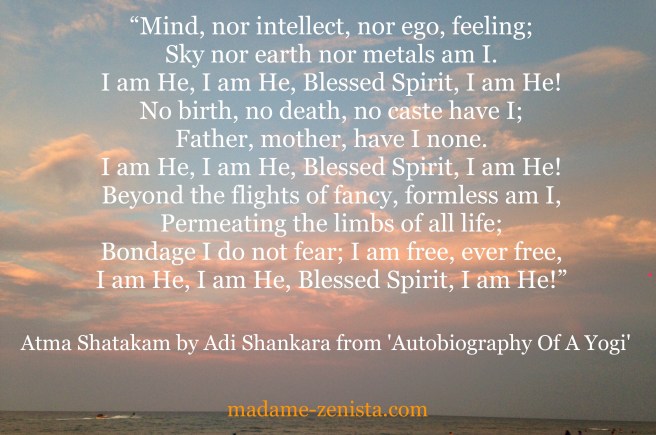
The occasion behooves the mention of Adi Shankara, the young Indian scholar and philosopher from the 8th century AD, who propounded the concept of Advaita or non-dualism (a-non, dvaita-two/dual). Advaita holds that the Creator is not distinct or separate from the Creation; that finite beings born of the Infinite are, therefore, themselves Infinite. So, as a young boy of eight wandering in search of a guru, Shankara encounters a seer who asks him “who are you?” Shankara responds in these six exalted Sanskrit stanzas that would be known as the Atma Shatakam. Below is a concise and beautiful translation of the sublime verses I took from the acclaimed spiritual classic and one of my favorite books, Autobiography Of A Yogi.
Atmashatakam by Adi Shankara. (Photo: South Padre Islands Beach. #nofilter)
One of the renditions of Atma Shaktakam (also called Nirvana Shatakam) that I love the best is from the album Sacred Chants of Shiva:
"What do we ever know that is higher than that power which, from time to time, seizes our lives, and reveals us startlingly to ourselves as creatures set down here bewildered?" -- Annie Dillard
Life according to one of life’s truly gifted naturally born wafflers… an open diary of a Saffer in a different land... life in the greater Dublin & Leinster area. (Blogging since 2011) My quests fuel my dreams… my dreams fuel my quests!!






 I am part of the
  The book:
 Being idealistic and passionate, I aspire to the ideal of minimalism. In principle, one doesn’t need to have what one doesn’t need to have. More and more, I look for meaning in things and people and relationships- quality, more than quantity. Have less things, but good ones that serve your purpose that you feel happy about. Don’t let the things you own, own you.

 Madame Zenista