
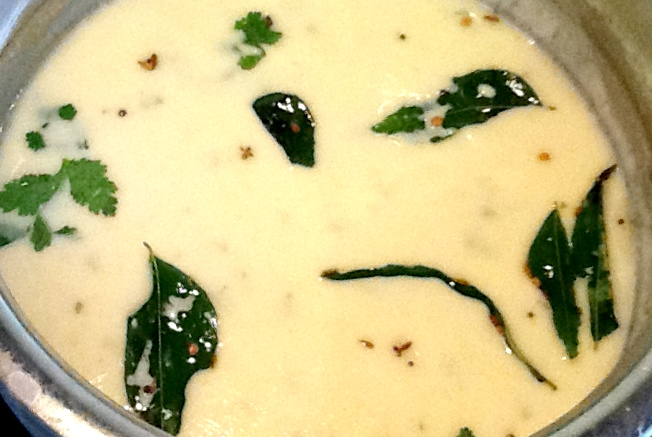
Maharashtrian Kadhi

Kadhi or kadi, is a hot Indian stew, slightly sour and tangy, that goes as a side dish with Indian food. Its as satisfying as having a hot soup on a chilly day. There are several ways to make it. As a matter of fact, there are variations in the style and recipe depending on which part of India its made – theres Punjabi kadi and the Sindhi kadi and the Gujrati kadhi… I grew up having my style of kadhi which was a trademark of our household. This is the Maharashtrian style kadhi that my mother makes to this day, at least a few times a week, and continues the yummy family tradition.

Typically, sour homemade yogurt is used that imparts a wonderful tangy flavor to the stew.

Heres the recipe I use:

Yogurt mix ingredients

1 cup plain yogurt + 2 cup water (Or, 1 cup plain yogurt + 1 cup 2% buttermilk + 1 cup water)
Additional 1/2 cup water

4 tsp of besan (chickpea flour)

1 tsp ginger garlic paste

1 tsp ground paste of : 1 medium hot green chilies (use 2 if you wish so),  few cumin seeds, a few coriander leaves (cilantro)

1 small pinch(literally) of turmeric

Salt to taste

Optional ingredients:

A few coriander leaves for garnish.

Some lime juice or amchoor powder (see Tip 2)

Sugar (see Tip 3)

Cream or sour cream ( see Tip 4)
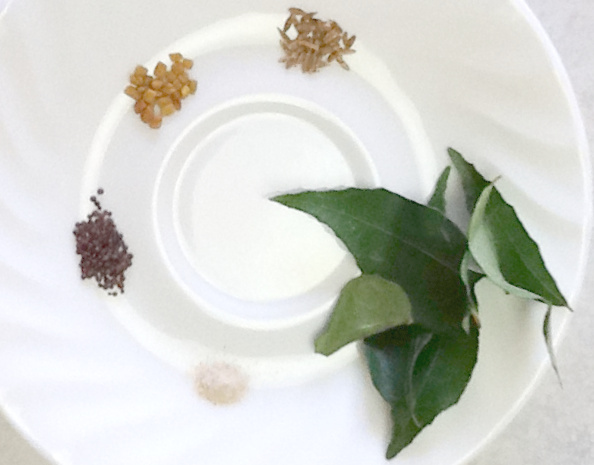
Kadhi tempering ingredients

For tempering:

2 tsp of cooking oil/ ghee

1/2 tsp of mustard seeds

1/2 tsp  cumin seeds

1/4 tsp methi seeds (fenugreek) (optional)

5-7 curry leaves

1 pinch hing (asafoetida)

1. Mixing and blending: Mix the yogurt, buttermilk and water and add besan, ginger garlic paste, the ground paste made of chillies, cumin and cilantro and salt if you wish (see tip 5). With a stick blender or whisks, blend it well to get a smooth texture without any flour lumps. Once done you can taste it to see if it tastes right. Add a teeny tiny pinch of turmeric to get a light yellow color like vanilla ice cream.

The consistency you have is how final product should be like. To this add another half a cup of waterthat would evaporate as you boil the mixture.

2. Cooking: On medium to high heat, bring the mixture to a boil  by continuously stirring it- it is critical NOT to multi task and leave the stew unattended. I tried to, in my first ambitious attempt, only to realize that the mixture had separated into a clear liquid and a granular looking yogurt mix. This means the kadhi has “busted”( as they’d say in Marathi!)

It should take about 12-15 mins to boil on medium heat. Let it boil for a minute or two and you are ready for tempering.

3. Tempering: Heat oil/ghee in a small skillet. Add asafoetida, mustard, methi and cumin seeds. Once sputtered, add the curry leaves. After about 30 seconds, pour the flavored oil in the boiled kadhi.

Hot Kadi is ready to serve with steaming hot white rice and a spoon of ghee.

Tips:  
1. Kadhi is made with sour homemade yogurt. But in its absence, store bought yogurt could be used.
-Store bought buttermilk could also be added which adds tanginess. 2% used in this recipe. If it’s whole or plain, then reduce quantity to 3/4 cup, and increase water to 3/4 cups.

2. Once done, to make the kadhi tangy, add few drops of lemon juice or amchoor  powder (made of sour green mangoes) according to your taste.

3. Some like their kadhi sweet and sour. For this, add 1 to 3 tsp (or more – adjust to taste) sugar at the end. Sweet and sour kadhi tastes yum- just try it for a small portion and check if you like it.

4. In my experience, kadhi made with fat free yogurt was a sheer disaster! Best use plain yogurt. Adding 1tbsp or so or cream or sour cream will add a deliciously creamy flavor, especially with 2% yogurt.

5. You can go low on salt while blending stage or entirely omit it. Add the required salt at the very end after the kadhi is done.  Why? If you work too hard and boil the stew to reduce it more than required (which will be actually nice), the salt proportion might go haywire!
Mommy ramble: My Broken Continuum

OUR FIRSTBORN:
I vividly remember the freezing night my husband took me to the hospital via the well rehearsed route, all packed up. Like most first time parents, we had all the time in the world to be over-prepared. The next day, little before noon, our first child was born. It’s interesting how the memory and pain of childbirth doesn’t linger on. I was given the baby immediately and as I held it for the very first time warm tears welled into my eyes. I glanced over to hubby standing by the bedside, and he smiled, his eyes moist. That moment is etched in my memory as truly the happiest and the most unforgettable one in my entire life. I was very tired and in a half-asleep state for most part of the day. But whenever I would wake up, I could see my baby in the hospital bassinet beside me, bundled and secured, yet lonely and all by himself. I wished it was by my side, but I didn’t say anything as I was not even fully awake, slightly disoriented and quite unsure if that would even make for a reasonable request. Our hospital offered a service to take care of the baby at night so the mother gets to take some rest. I was asked to go for it (a ‘wise’ thing to do without getting ’emotional’ for my own ‘good’). That separation tore me deep down. I had neither the experience nor conviction to choose the right thing, as I can see it now.

POSTPARTUM DEPRESSION
Once we got home, it was such a hostile sight for me to see the tiny bundle in this large oversized crib. I was told not to cosleep with the baby as a new sleep-deprived mom could accidentally smother the baby. Trying to abide by these “do’s and don’ts”, while my instinct rebelling subtly but surely inside of me, created a distressing inner conflict. Finally, I confided in hubby and we got this big rectangular plastic box (with sides short enough to let me see the inside, lying down), put in a soft cloth padding, and started having it by my side with the baby in it.

FORMULA OR MOTHERS MILK:
Before his birth, when asked if I’d be giving formula or breastfeed the baby, I remember writing “both”, having no idea whatsoever of how important that question was. It’s only with my second baby did I realize the difference it made! During the postpartum weeks that followed, I felt something was amiss, and I’d feel very low and disinterested. On top of it, I was struggling with latching (as the baby was also given a bottle since birth) and lactation issues like most first time mothers, which was not helping my situation either. It is only a few years later that I would know how interrelated it all was. My mother would often try to talk me out of my misery by telling me that I had a healthy baby, a loving husband, my parents around and so there was really no reason not to be happy. She was right, but I couldn’t help it much. I was grieving for something that I couldn’t put a finger on, yet it was very much there, lurking somewhere.

BACK TO WORK and THE MOVE
I resumed work after the 3-month maternity leave. Needless to say, it was tough leaving the baby, although he would be home and not in a daycare, under the the loving care of my mother in law. The separation felt unnatural to me. But the whole world around me seemed to follow this norm, so it must be a ‘reasonably right’ thing to do, I would tell myself trying to assuage the trauma. It might appear strange when I say this, but I would not call home very often from work to check on the baby. I couldn’t. I was in denial…

Thankfully, it was not for long that I had to go through the ordeal. Hubby switched jobs and we had to move out of town, a few driving hours away. I quit after working for a few months. In hindsight, this was one of the best things that could have happened to me after I became a mother. I can’t be thankful enough as I would not have quit of my own volition, primarily because I was unsure if it was a even ‘rational’ option I had the luxury to exercise. I loved being not having to be away from my son, but there still was an undertone of something I was missing or perhaps was angry about. I was irritable and would have an angry outburst here and there, until I finally got over it a year or so later.

OUR SECOND:
Our second child was born after a gap of two years. To my pleasant surprise, everything was so much easier and better, as it usually is for the mother second time around. This was also the time when we moved again, this time from the Midwest to the Southwest (a bigger move) when the baby was but 5 weeks old! We moved into a couple of temporary corporate houses before we settled for the permanent one. In spite of all these changes and activity around us, everything seemed to work out just fine, the baby was content and I was cheerful, with no issues with lactation or latching. So much so that I donated about two and a half gallons of excess expressed milk (immensely satisfying to be able to help premature babies in need ones own little way, also a grateful reminder to all of one’s blessings!)

THE CONTINUUM CONCEPT- a book that put it all into perspective.
I read The Continuum Concept 6-8 months after my second child was born. It answered why the two pregnancies were so different. As soon as Baby#2 was born, I had him with me for over an hour before they took him away to bathe etc. I didn’t put him in the bassinet but for a few times, but had him by me almost all the time (and yes, I didn’t smother him a even a little!). I didn’t care if I was going against the ‘norm’. I was so sure, so confident. He was with me all of the time, or his father/grandmother/uncle at some other times. I had no postpartum depression and the baby had nothing to complain or cry. This time everything was in line with the ‘continuum’, the way it should be. Both are good kids, I still see a lot of difference between my two boys in their disposition and demeanor.

If only I had known about the continuum concept before, I would have had the courage to follow the feeble voice within me. There is a lot of literature available on parenting, especially for first time parents. But there’s only some that is very crucial, and this book is one such. If I was to go back in time and change one thing, I would make my decisions differently moments after the birth of my first child, the continuum way!

This excerpt is written with a sincere hope that some future mothers stumble upon this post and explore Continuum philosophy, which is nothing but parenting by instinct, the natural way.

Suggested reading and resources
The website: http://www.continuum-concept.org/index.html
The super excellent forum the wealth of wisdom from Continuum mothers/parents: http://www.continuum-concept.org/forum/index.html

Book Review: The Continuum Concept

This is a must read for all parents to be.
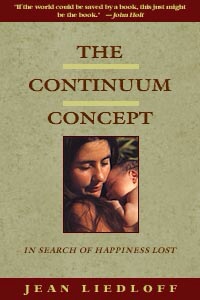
The Continuum Concept by Jean Liedloff

The Continuum Concept is a book that blew my mind; I had read nothing like this before! The author Jean Liedloff spent two and a half years deep in the South American jungle living with Stone Age Indians of the Yequana tribe. This experience demolished her Western preconceptions of how we should live, and led her to a radically different view of what human nature really is. She shows us how we have lost much of our natural well-being and suggests practical ways to regain it for our children and for ourselves.

The continuum theory: “In order to achieve optimal physical, mental and emotional development, human beings, especially babies, require the kind of experience to which our human species adapted during the long process of our evolution.”

Parenting:
That said, the book brings forth ideas in stark contrast to the prevailing practices in the western world. I have to write this: there were some excerpts which were quite unsettling to me that I had to stop, collect myself and with all the courage go back to reading it; who wouldn’t be vulnerable to the idea of babies suffering? The worst part is, this ‘mistreatment’ happens at the hands of parents/ caregivers with much misguided ideas. And that is precisely why it has become my mission of sorts to strongly recommend this book to new mothers or mothers to be.

The book gives some basic practices during the initial moments, weeks and months after a child is born: constant physical contact with the mother/caregiver, co-sleeping, breast feeding on cue (and not trying to ‘discipline’ the baby at this stage by feeding at intervals that you set for them), carrying the baby around in arms, immediately responding to the child’s signals and so on. Is this not something that a mother would instinctively do, only if she is allowed to do so and not ill-tutored otherwise? Of course! However, we have some popular theories to care for the newborn that are just the opposite!

Postpartum depression: The moment the baby is born, the mother is keyed in to hold the baby, nurse and caress it. If this stimulus is not met with this right response and those moments missed, then when hours or even minutes later, the baby is finally brought to her, the mother has already gone into a psycho-biological state of mourning. The result is often that she feels guilty about not being able to ‘turn on mothering’, or to ‘love the baby very much’ as well as suffering the classic civilized tragedy called normal postpartum depressionjust when nature had her exquisitely primed for one of the deepest and most influential emotional events of her life! How unfortunate is that!

It was after reading this book that I could make sense of the what was going on with me after my first child was born (more about it in another post here).

Ancient postpartum care:
Some olden cultures have practices that are very much in line with the continuum, like the ones prevailing in India for a few thousand years (though the ‘modern’ winds are changing these ways for the worse). The mother is exclusively available for the newborn as she and the baby are assigned and confined to a room that’s not too bright (so as not to inconvenience the newborn, I guess) for 40 days. She nurses him on cue, co sleeps with the baby, gets her daily body massage, not allowed to use cold water, served fresh off the stove nutritious meals (fresh hot food is much easier to digest, especially when the new mothers digestive system is still weak) and she is assigned no housework. Elderly women – be she a distant relative, friend or even a neighbor – would come to live with them and assist the household with chores, caring for the baby and the new mother, and offer a wealth wisdom for the two. What a fantastic system it used be in the olden days! Anyway, that’s a topic in itself.

Some important continuum ideas:
The book talks about several concepts like: what the baby feels before he can think is a powerful determinant of what kind of things he thinks when thought becomes possible, and how the child’s general outlook towards life and living is shaped. Many psychological patterns, addictions, attitude, including possibly homosexuality, Liedloff believes, have their roots in the treatment of the child during their stages of infancy and childhood. Its remarkable how the Yequana treat their children that shows inherent respect and intrinsic trust. It’s all so wonderful and gives us a hopeful solution for our entire society.

The book spoke to my heart. Theories come and theories go. But what is important, I think, is that parenting in general should never be influenced by these external hypothesess, but always be guided by one’s instinct within. Be assured, with it you’ll be right on the money!

Important questions to ask oneself:
Am I (like perhaps most others), a victim of incomplete childhood? Is there something missing that I am continually looking for – an innate sense of well being and happiness-‘a natural state of being’- that seems elusive (e.g. the idea that ‘being in love would make it all right’)? Is there some emptiness that doesn’t seem to fill me up? I found some amazing perceptions that I never found in the myriad spiritual and self-help literature I’ve read for over two decades. The book put to rest some questions that had plagued me forever.

My last word:
I strongly recommend this book for two groups: those who are going to be new parents and those who have been babies at one point or another. I can’t emphasize enough- it’s a book not worth passing.

Resources to check out:
The website: http://www.continuum-concept.org/index.html
The super excellent forum: http://www.continuum-concept.org/forum/index.html (the wealth of wisdom from Continuum mothers/parents here is outstanding)

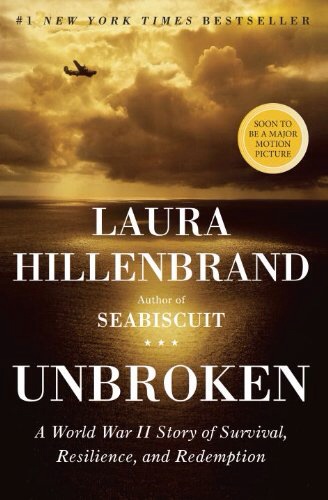
Book Review: UNBROKEN: A World War II Story Of Survival, Resilience, and Redemption

IMG_0585.JPG
What a ride!

This is a brief account of how the book affected and touched me, more than a ‘review’. This is my first book ever on the World War II, a topic I’ve always fought shy of. Deep down, I have always evaded having to live the vulnerability, suffering and horror that war brings upon people. But the fear of the idea of something is much different from and more terrifying than what it really is. This was true for me having read the book.

A gripping tale of a man and his determination, survival and optimism. I was astonished to see the human capacity to inflict cruelty and so also the human potential for endurance- and none of which was fiction! Reading though the book, I lived the life of a POW (Prisoner of War) in extreme suffering and continual dread, with no hope day after day, week after week, month after month and year after year. Then Hiroshima-Nagasaki bombings happen. It’s then that I saw the significance of it and the other side of how that finally put an end to the war! The jubilation of American victory to end the six years of misery and hardship for the whole world, put me in tearful awe. I empathized more than ever with the war veterans, and how the war experiences change them for good, and their difficulties in settling back to a ‘normal’ civilian life (if they return alive, without losing a limb or so)! It’s not just the physical, but the mental trying, that leaves the lifelong scars. And each one has to find his way out, and live amongst those who have no idea of what all their souls have endured!

Also, it gives us a reality check on our lives which is no less than kings and queens, so we better stop complaining for whatever it is!

For those who are deciding still, whether or not to read the book, this is what I have to say: it’s great storytelling, thrilling, gripping and awe inspiring. Like me, you wouldn’t leave it, if you get past the first chapter!

Sidewalls (Medianeras): The Movie

One weekend, while going through the Foreign Films category on Netflix, hubby P came across the Spanish movie  “Medianeras”, literally meaning “Sidewalls“. Unlike the front or the back of buildings that have balconies or grand entrances or decorative motives, sidewalls are the useless parts, at best used as a canvas for advertising something.

Set in Argentinian capital of Buenos Aires, one of the largest cities in the world, the movie begins with pointing out a striking correlation between the architecture of the city with dissimilar buildings, and its inhabitants. We create cities in our own image which reflect our own lives – unplanned, chaotic, contradictory, hostile, unpredictable. These cities charm us, yet there is the all pervasive “urban loneliness”- the isolation in a big crowd and an eerie silence within amongst loud noise without !

With this backdrop is the story of the protagonists of the movie, Martin and Mariana. They are both loners and have their phobias or neuroses they are dealing with. Martin is a web designer and most of the last decade has been a denizen of cyberspace, locked up in his tiny “shoe box” apartment. It is similar to Marianas apartment in the neighboring building who moved in after her failed relationship. She is an architect by qualification but is decorating shop windows. They both need love but the feeble attempts they make at attaining it only proves what misfits they are amongst the ‘regular’ lot! It wont take long to realize that they both, however, could be such perfect compliments to one another, only if they meet. But how?

Medianeras Martin and Mariana
Martin and Mariana cross paths living in the same block, never to meet…

They decide to break open small windows in their sidewalls to let some sunshine into their dark and dingy homes. How does that change things? Watch the movie to find out 🙂

There are a few very interesting themes running in the film contemporary to our generation: the ever-growing big cities with the changing (not ‘evolving’) architecture, its sure impact on peoples lifestyles and lives, technology and internet that made the world a global village keeping us apart, and the search for love.

The movie is the Director Gustavo Tarreto’s debut feature, based on his 2005 short film based on the same name. There are very few characters. Most of the film is a voice over as the thoughts of the two main characters which makes it very easy to identify with them in a short time. Its a cleverly made film with subtle humor and a delightful ending.

If you are one of those, like me, who are constantly looking for good cinema, and secretly wish for happy endings, this one is for you!